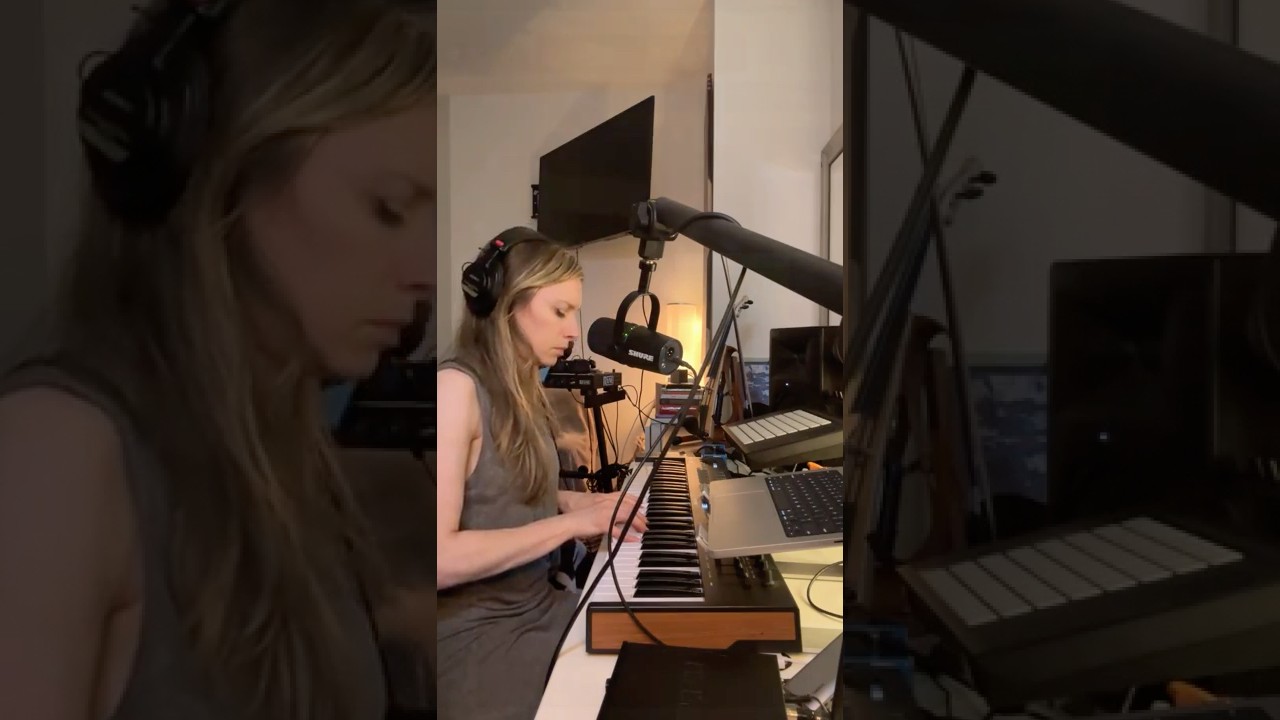
The Foundation: Strings & Bass
The whole track starts with chords. Not a synth pad pretending to be strings — actual strings, played with the kind of articulations you can't fake. Spitfire Audio Abbey Road Two: Iconic Strings is the first plugin in the chain. The ensemble patch is what does the heavy lifting: it puts the entire string section in front of you, and the controls let you push the tone from intimate close-mic to room-soaked Abbey Road wash. I start with a basic four-chord progression — long, sustained, no rhythmic articulation — just the chord bed.
To layer in detail, I go back to Spitfire Audio BBC Symphony Orchestra. There's a 16-player section in there that sits beautifully under the Abbey Road ensemble — closer mic position, more bow noise, more individual character. Stacking the two libraries gives the chord bed real depth: one library for size, the other for grain.
Then the bass. House tracks usually run on a sub-synth or a Moog-style mono bass. Instead, I'm using BBC Symphony Orchestra's double bass — the actual orchestral instrument. Pizzicato hits and short sustained notes, played on the root of each chord. It's surprisingly punchy when you commit to it, and it sits in a totally different frequency pocket than a synth bass would.
Creative Sound Design: A Choir-Made Snare
Now for the rule break. There's no drum machine in this session, so the snare needs to come from somewhere else. I pulled up Spitfire Audio Eric Whitacre Choir — a sample library built from layered choral recordings — and started chopping. The trick: take a single short choral hit, pitch it down, add transient shaping, and use it as a snare on the 2 and the 4.
It doesn't sound like a snare in the traditional sense. It sounds like a breath, or a percussive vocal tic — closer to a clap-and-vocal hybrid than anything from a 909. Which is exactly the point. The track now has a rhythmic backbone, but the backbone has texture and human grain instead of a sample-pack drum hit.
The most interesting beats usually come from misusing an instrument the library wasn't designed for.
Mixing & Textures
Sidechaining the Low End
Once the choir-snare is locked in, the kick goes back in. Standard four-on-the-floor, low-mid weight, nothing fancy. But the orchestral double bass is now stepping all over the kick's frequency range — every time the kick hits, the bass note muddies the transient. Solution: sidechain compression, but only on the lows.
I'm using Cableguys ShaperBox for this. Specifically the VolumeShaper module, which lets you draw a precise volume envelope locked to the kick's tempo. The trick that ShaperBox handles better than a normal compressor: frequency-band-specific sidechain. Instead of ducking the entire bass on every kick, you can isolate the lows (say, below 120 Hz) and only duck that band. The result is the kick punching through cleanly while the upper-bass body of the double bass keeps playing — no audible pumping on the harmonic content, just a clean low-end pocket carved out for the kick.
Spatial Effects: Granular Reverb & Delay
The chord bed by itself is too clean. Real Abbey Road strings recorded in a real room are full of air and reflection — but the dry samples don't always deliver enough of that, and at this point in the arrangement the track needs movement. Two plugins handle that.
First: Output Portal, dropped on the main string chord bus. Portal is a granular processor — it chops audio into tiny grains and lets you re-pitch, reverse, or shimmer them out into the stereo field. On strings, with the granular size set short and the wet signal subtle, it adds a halo of pitched air around the chords. Not so much that the chords sound granular — just enough that there's a sense of the room breathing.
Second: Baby Audio Spaced Out. This is one of my favorite reverbs because it bakes a delay tail into the verb itself, so you get reverb and rhythmic echo from a single instance. On the strings it creates contrast — the dry chord hits, the room blooms, then the delay echoes the tail across the stereo field. Used sparingly, it makes a 4-bar loop feel like 8.
Putting It Together
What you're left with is a deep house track where every sound comes from an orchestral source — strings, choir, double bass — but the arrangement reads as house. Four-on-the-floor pulse. Sidechained low end. Stereo-wide reverb. Vocal-derived percussion on 2 and 4. The genre conventions are all there; only the instrumentation is unusual.
This is the kind of approach that's worth pulling out when a track feels too templated. You don't need to throw out the formula — you just swap one variable and let the rest of the rules do the work. Strings instead of pads. Choir instead of a snare. Real double bass instead of a Moog. The framework holds; the texture changes completely.
Want to use these techniques in your own track?
Browse the sample-pack catalog for live violin, piano, vocal hooks, and MIDI loops — or book Julie for a hybrid DJ/violin set at your event.